Korean companies have changed their titles; The harder task is changing how decisions are made
9 November 2026 — Korean companies have simplified hierarchies, but effective leadership requires more. Clear roles, selecting leaders for future demands, and genuine decision-making authority are key to meaningful reform.







Problem
Visible changes do not guarantee better decisions. Leadership roles may duplicate the work below them, appointments may reward past performance without establishing readiness, and executive intervention can undermine delegated authority. Decisions then move upward, delaying action and leaving managers accountable for outcomes they cannot fully control.
Why it happens?
Korean corporations have simplified ranks and titles and relaxed promotion rules tied to seniority. These reforms aim to reduce status barriers and give greater weight to roles and performance. They also create an opportunity to examine what each leadership level contributes and how decisions are made.
Solution
Align leadership roles, selection and authority. Define the judgment each level must contribute, assess people against the work ahead, and provide the mandate and resources to deliver. Senior executives should uphold delegated authority and review actual decisions to identify where role design, capability or management practice needs to change.
Download this post (PDF)
Korean companies have spent years reforming seniority-based HR systems. Samsung Electronics reduced seven employee ranks to four career levels in 2017 and removed rank and seniority information from its internal system in 2022[1]. Hyundai Motor and Kia announced simpler grades and titles and removed minimum service requirements for promotion in 2019[2].
These reforms can reduce status barriers and change how people are recognized, assessed and promoted. But they do not establish what judgment each leadership role should contribute or whether delegated authority holds in practice.
Pricing exceptions may still pass through several senior desks. Division heads may remain accountable for results while waiting for headquarters to settle key trade-offs. Executive committees may reopen decisions they have already delegated.
These delays carry a commercial cost. Customers may turn to competitors while the sales team waits for pricing approval. Capacity expansion can fall behind demand as investment priorities remain unresolved. Repeated reviews also consume executive time that could be spent on the broader investment and growth decisions requiring their judgment.
In one Reddal engagement, a founder-led design firm faced project delays and missed revenue targets as unclear responsibilities left decisions repeatedly returning to the CEO. Over six months, we helped clarify leadership responsibilities and decision rights, strengthen the PMO’s authority, and establish more reliable financial reporting and focused management reviews. Meetings shifted toward decisions, named owners and deadlines, supported by weekly and monthly follow-up. The results became particularly visible in the latest monthly review: the reported year-to-date revenue shortfall narrowed from 36% to 4% of target, while EBIT margin rose from 30% to 40%. These improvements reflected several changes; clearer accountability, better financial information and disciplined execution likely contributed.
Larger organizations can face a similar problem when managers are accountable for results but important decisions continue to return to the most senior executives. For Korean companies reforming their hierarchies, this makes the allocation and exercise of authority a practical test of whether those reforms are changing how the business is run.
For Korean corporations trying to move beyond seniority-based management, three questions matter more than the organization chart:
- What judgment should each leadership role contribute?
- Who is ready to exercise that judgment?
- Does that person have the authority to act?
These questions are connected. A company cannot select the right leader until it has defined the work of the role. Nor does a well-chosen leader add much value if their decisions are routinely reopened by someone more senior.
First, define what each leadership level must contribute
Large corporations need hierarchy. A plant, a business division and a corporate group face decisions with different consequences. Someone has to resolve conflicts across functions, allocate capital between businesses and take responsibility for choices that extend beyond the next quarter.
Each level should therefore contribute judgment that the level below cannot reasonably provide.
A plant manager may focus on improving yield, reducing downtime and meeting delivery commitments. A division head must consider how the plants work together: where capacity should be added, which technology investments deserve priority and when an attractive order at one plant would create costs elsewhere in the business. At group level, the work may involve choosing between businesses and deciding which capabilities to build for future growth.
These distinctions need to be explicit. A broader title, more direct reports or a larger budget does not by itself explain what a leadership role is there to do.
Elliott Jaques’s work offers a useful starting point. With Stephen Clement, he distinguished levels of work by their complexity and time horizon and argued that managerial roles require capabilities suited to those demands[3]. His broader claims about measuring human capability remain contested, and the framework should not be treated as a ready-made template[4]. But the underlying question remains useful: what is the distinct work of the next level?
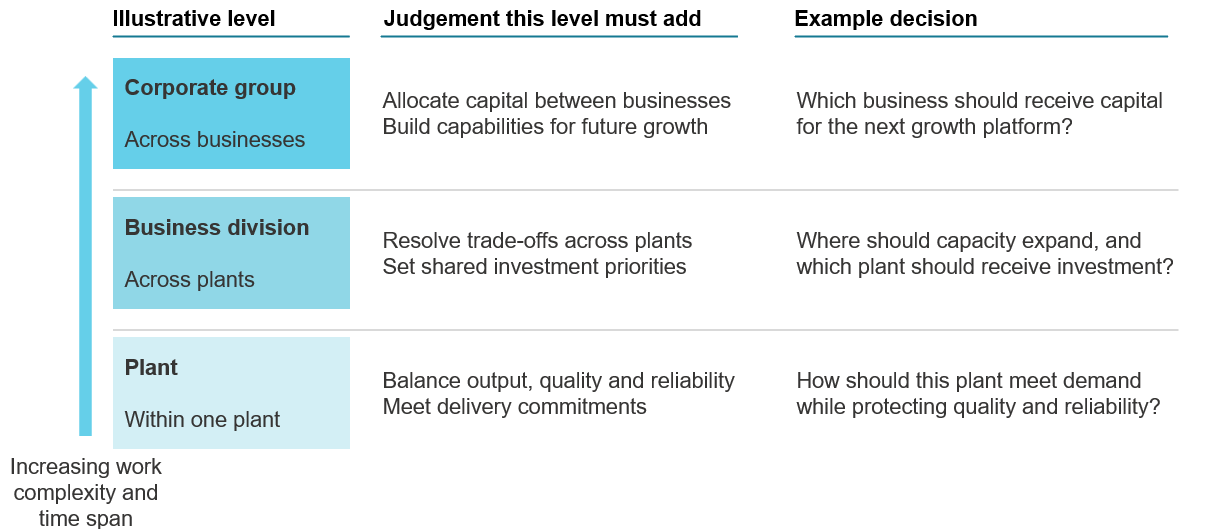
If a division head mainly rechecks operating decisions already made by plant managers, the company should first examine the role’s purpose. Which unresolved trade-offs require that level’s attention? Which decisions need a view across plants? What future needs would otherwise receive too little attention?
Without clear answers, hierarchy can add review while leaving essential leadership work undone. Operating decisions pass through more desks, while investment priorities, capacity conflicts and future capabilities remain unresolved.
A well-defined role makes its contribution clear: the decisions it owns, the trade-offs it must resolve, the time horizon it must consider and the outcomes for which it is accountable. This gives the organization a basis for deciding whether the level is needed, and, if it is, what it should deliver.
Second, select leaders for the work ahead
Once the work is clear, the next question is who is ready to perform it.
Leadership appointments often serve two purposes at once. They assign responsibility for future work, but they also recognize years of service, loyalty, technical expertise and past contribution. Those purposes do not always align.
A respected executive may have served the company exceptionally well without being suited to a role whose demands have changed. A younger manager with strong results may still need to develop the judgment required for broader responsibility.
Removing minimum service requirements and expanding the candidate pool can help. But a wider pool only improves selection if the company has a better way to assess the people within it.
Selection discussions should ask what evidence shows that the candidate can handle the role’s demands.
Annual performance ratings provide part of the answer. They show how someone delivered in an existing assignment, but they may reveal much less about whether that person can resolve conflicting objectives across businesses, allocate scarce resources or make choices whose consequences emerge years later.
Research illustrates the risk. In a study of sales employees across 131 firms, Alan Benson, Danielle Li and Kelly Shue found that companies prioritized current sales performance in promotion decisions over other observable characteristics that better predicted managerial performance[5]. Strong results in one job do not necessarily establish readiness for the next.
Succession discussions should therefore examine decisions and assignments that reveal the judgment needed ahead. How did the candidate handle competing objectives? Did they bring different functions to a workable conclusion? Did they recognize the limits of their own expertise? Have they taken responsibility beyond their direct function? Where evidence is missing, a broader assignment can help both develop and assess readiness.
Third, make authority real
Selecting a capable leader is not enough. The organization must allow them to lead. Consider a division head with formal authority to approve expenditure within an agreed budget. Before acting, the person briefs a more senior executive. The briefing leads to another consultation, then a revised proposal. By the time the approval is recorded, several people have effectively made the decision already.
In this situation, reporting has become difficult to distinguish from asking permission.
Economists Philippe Aghion and Jean Tirole distinguish between formal authority, the right to decide, and real authority, effective control over decisions[6]. That distinction helps explain why a delegation document may tell us little about who makes the call.
The written rules give the division head authority. The unwritten rule says that acting without advance agreement is risky. A manager who understands that rule will seek clearance, however often the company says it wants initiative.
This is not unique to Korea, but the Korean context can make it harder to address. Age, entry cohort, tenure and personal relationships can sit alongside formal reporting lines as signals of whose judgment will ultimately prevail. A younger leader may find a mandate bypassed by an older colleague. A long-serving executive may find a decision overturned by someone with closer access to the CEO.
Repeated executive intervention teaches the organization quickly. When a manager’s decision is reopened even though it falls within an agreed mandate, employees learn that the senior executive remains the real decision-maker. Seeking advance clearance becomes rational. What looks like a lack of initiative may be a sensible response to the way authority works.
That does not mean escalation should disappear. Some decisions properly belong at a higher level: those involving major investment, enterprise risk or a trade-off that one business unit cannot settle alone. But the threshold should be clear. Escalation should follow agreed limits or a material change in risk, not a senior executive’s preference to revisit every difficult call.
A credible hierarchy distinguishes consultation from approval. The role holder must seek relevant information and consider others’ views, including those with greater experience. But consultation should not give those colleagues an informal veto: within the agreed mandate, the role holder retains authority and accountability to decide.
Put the three questions together
Consider a capacity conflict between manufacturing plants that repeatedly reaches the CEO. Does the division head’s role clearly include resolving it? Has the person demonstrated the judgment required? Can they set priorities and allocate resources within agreed limits? The answer determines whether the company needs to clarify the role, develop the leader or make the authority effective.
The same logic applies to overseas operations, AI transformation and shared corporate functions. A country head cannot reasonably be held accountable for growth while commercial adaptations within an agreed mandate still require Seoul’s approval. An AI program leader cannot improve a process if they can run pilots but cannot change incentives, secure people’s time or resolve conflicts between IT, risk and business. A task force does not solve a decision problem if none of its members can make the decision.
What senior leaders can do now
The next promotion cycle or business review is enough to begin. A company does not need a company-wide reorganization first.
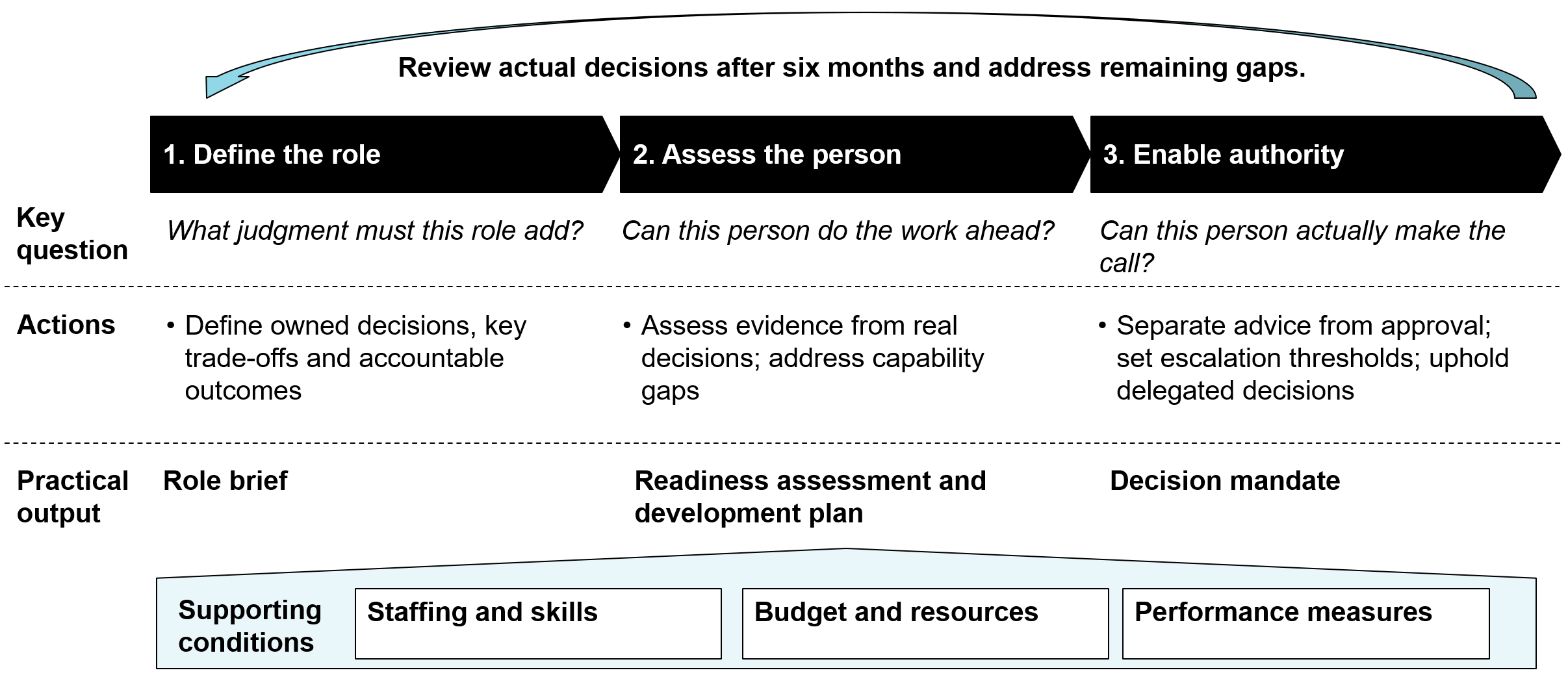
The CEO and business leaders can start by reviewing the last ten decisions escalated to the executive committee. Include a few decisions delayed by informal clearance, even if they never formally reached the committee. For each, ask:
- Who was originally expected to make the decision, and who actually made it?
- Why was it escalated?
- What additional judgment did senior management contribute?
- How much delay did the escalation create, and what business consequences followed?
Some escalations will have been justified. Where they were not, examine whether the underlying problem was an unclear role, a leader unprepared for the decision or authority that did not hold in practice. Use these findings to select a small number of roles for closer review. For each role, define the few judgments it is expected to contribute, the decisions it owns, the trade-offs it must resolve and the outcomes it is accountable for.
The CEO, business leaders and HR should then assess the role holder or candidate against the work ahead, not only against past results, tenure or technical reputation. Use real assignments and decisions as evidence. If the person needs development, make that explicit and give them opportunities to demonstrate readiness before the appointment becomes permanent.
Next, make the mandate usable. Put key decision rights, consultation requirements and escalation thresholds on one page. Distinguish who recommends, whose agreement is required, who provides input, who decides and who implements the decision. These are the separate responsibilities identified in the RAPID framework developed by Paul Rogers and Marcia Blenko[7]. The practical point is straightforward: giving advice should not quietly become a right of approval.
HR and finance need to help align staffing processes, budget rules and performance measures with that mandate. A leader cannot be held accountable for a result while the resources and decisions that shape it remain elsewhere.
Senior executives also need to change their own habits. When someone appeals a delegated decision, the first question should be whether the manager acted within the mandate. If they did, a different personal preference is not enough reason to take the decision back. When intervention is necessary, explain why: a boundary was crossed, material new information emerged, or the risk changed.
Alongside the ten-decision review, record how many decisions reach the executive committee over a defined period and how long they take from the original request to a final decision. Six months later, compare these measures over a comparable period and repeat the ten-decision review. Are routine issues being resolved at the right level? Is senior review contributing useful judgment? Also examine decisions made within the delegated mandate: are they timely and producing the intended results? Where problems persist, trace what happened and identify what still needs to change.
Korean corporations have already changed important parts of their HR systems. But the CEO and senior executives must carry those reforms through to the way decisions are made. HR can clarify roles and improve promotion criteria, but these changes will have little effect if executives keep taking back decisions they have delegated. The real test is whether senior leaders are willing to let managers use the authority they have been given.
References
[1] Samsung Electronics (n.d.). Culture of Mutual Respect, at https://www.samsung.com/global/sustainability/popup/popup_doc/AYUqrLnaDZMAIx_C/.
[2] Kyunghyang Shinmun (2019). 현대차와 기아차, 동료끼리 장단점 조언해주는 인사 제도 마련 [Hyundai and Kia introduce an HR system incorporating peer feedback], at https://www.khan.co.kr/article/201909021013011.
[3] Jaques, E. and Clement, S. D. (1994). Executive Leadership: A Practical Guide to Managing Complexity, Wiley, at https://www.wiley-vch.de/en/areas-interest/finance-economics-law/executive-leadership-978-0-631-19313-5.
[4] Kleiner, A. (2001). Elliott Jaques Levels With You, strategy+business, at https://www.strategy-business.com/article/10938.
[5] Benson, A., Li, D. and Shue, K. (2019). Promotions and the Peter Principle, The Quarterly Journal of Economics, 134(4), at https://doi.org/10.1093/qje/qjz022.
[6] Aghion, P. and Tirole, J. (1997). Formal and Real Authority in Organizations, Journal of Political Economy, 105(1), pp. 1–29, at https://doi.org/10.1086/262063.
[7] Rogers, P. and Blenko, M. (2006). Who Has the D? How Clear Decision Roles Enhance Organizational Performance, Harvard Business Review, available through Bain & Company at https://www.bain.com/insights/who-has-d-how-clear-decision-roles-enhance-organizational-performance/.
Tags
Korea, Korean corporate governance, Leadership, Organizational transformation, Decision-making