From crisis management to performance discipline: A practical turnaround framework
4 September 2026 — In corporate distress, survival depends first on decisive leadership, close collaboration, and immediate cash actions. AI can further strengthen visibility and forecasting, while disciplined governance helps turn a liquidity crisis into recovery and sustained performance.






Problem
Companies in distress can face rapid liquidity shortages and risk insolvency unless immediate corrective actions are taken. Limited visibility to daily cash balances, weak group - local coordination, and forecasts not linked to operations delay responses. A strategic turnaround built on treasury-led discipline, collaboration, and AI-powered forecasting restores liquidity, reduces risk, and creates the foundation for sustainable growth and recovery.
Why it happens?
Companies in distress can face rapid liquidity shortages and risk insolvency unless immediate corrective actions are taken. Limited visibility to daily cash balances, weak group - local coordination, and forecasts not linked to operations delay responses. A strategic turnaround built on treasury-led discipline, collaboration, and AI-powered forecasting restores liquidity, reduces risk, and creates the foundation for sustainable growth and recovery.
Solution
Companies in distress can face rapid liquidity shortages and risk insolvency unless immediate corrective actions are taken. Limited visibility to daily cash balances, weak group - local coordination, and forecasts not linked to operations delay responses. A strategic turnaround built on treasury-led discipline, collaboration, and AI-powered forecasting restores liquidity, reduces risk, and creates the foundation for sustainable growth and recovery.
Download this post (PDF)
Corporate distress resembles an uphill battle against fierce headwinds. Drawing on Reddal’s experience supporting companies under financial pressure, this article outlines six steps: stabilize liquidity, reset leadership, diagnose rapidly, execute targeted actions, enforce rigorous governance, and secure sustainable growth. In one global manufacturing case, rolling cash forecasts and working-capital actions helped release a double-digit million euro amount within six months amid declining demand and accelerating cash burn. Liquidity provides the financial foundation to stabilize the business, leadership sets priorities and pace, and clear performance metrics show whether corrective actions deliver results. Together, these disciplines help turn short-term crisis management into sustained performance improvement.
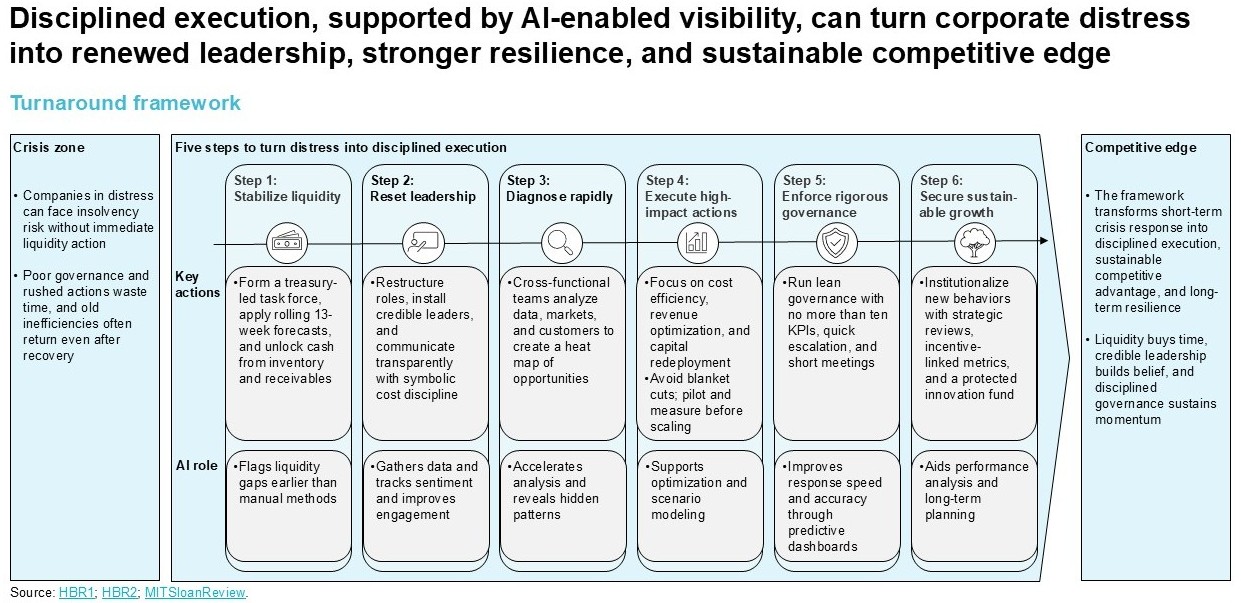
Step 1: Stabilize cash and liquidity
The first and most immediate goal in any turnaround is survival. Without liquidity, a company can quickly face insolvency, making rapid cash control essential from day one. A cross-functional, treasury-led task force should take ownership of daily cash visibility, payment prioritization, and short-term liquidity decisions.
Reliable short-term visibility is essential to effective cash control. A rolling 13-week cash forecast, linked to bank feeds, ERP data, and key operational drivers, helps identify liquidity gaps before they become critical. AI can further improve cash forecasting by analyzing large volumes of payment and collection data faster than manual review, helping treasury teams identify emerging liquidity risks earlier. This gives management more time to update cash flow scenarios, reprioritize payments, and take corrective action, while reducing manual effort and the risk of costly last-minute liquidity measures.
Technology can improve visibility, but human judgment remains essential in deciding how cash is used. The treasury-led team must evaluate and authorize payments carefully, ensuring that each expenditure directly supports short-term survival. At the same time, aggressive working capital management can release trapped liquidity. Inventory should be categorized immediately into keep, sell, or salvage groups, while receivables teams should contact customers ahead of due dates to improve collection predictability.
Equally critical is maintaining full visibility into daily cash balances across the group. A centralized cash pool provides immediate transparency and liquidity optimization, but if pooling is unavailable, close collaboration and coordination between group treasury and local entities becomes indispensable. Aligning information flows and reconciliations at both levels ensures funds are deployed where needed most, preventing local shortages from escalating into broader crises.
Forecasts should not be managed in isolation but directly tied to business operations. Linking cash forecasts with underlying drivers – such as sales volumes, order intake, and production plans – provides early warning of liquidity risks and enables proactive hedging or operational adjustments. For example, lower sales volumes may signal slower collection of receivables. Understanding these dynamics helps the treasury team not only identify risks but also drive corrective actions across the business.
The forecast should include best-case and worst-case scenarios, with regular reconciliation against actual cash balances to improve accuracy and build operational confidence.
Step 2: Reset leadership and reinforce culture
Liquidity management provides critical breathing space, but long-term turnaround success depends on cultivating employee belief and engagement. Harvard Business Review article on the psychology of turnarounds reminds us that employees must first believe the effort is worth their discretionary energy[1]. Achieving this requires swift, decisive leadership action. Within weeks, review and restructure leadership roles, appointing competent, credible figures capable of driving necessary changes. Effective leaders communicate clearly, regularly, and transparently, reinforcing the urgency and significance of turnaround objectives.
Symbolic leadership actions are essential for building trust during a turnaround. Leaders must visibly adhere to cost-cutting measures; for instance, executives should switch to economy-class travel if budgets require visible cost discipline. Such symbolic actions reinforce the sincerity and seriousness of leadership's commitment. Regular communication can also reduce uncertainty and help employees stay focused during a turnaround. Research on organizational change suggests that high-quality change communication can reduce uncertainty and improve openness to change[2]. In challenging situations, management should establish a clear mandate and shared understanding of the situation, agree on the principles guiding key decisions, and communicate these consistently across the organization. This provides employees with a common direction while ensuring that actions and messages remain coordinated across the management team.
However, superficial changes, such as cosmetic leadership title shifts or new slide decks without tangible progress, often harm morale rather than help. Expectations for new leadership roles should therefore be clearly defined, with measurable deliverables and explicit accountability. Progress against these deliverables should be communicated regularly, with public updates focused on the most critical and actionable messages.
Step 3: Conduct rapid diagnostics
Once immediate liquidity is under control, management needs to identify where value is leaking and which issues require action first. The diagnostic should combine financial and operational data with input from customers and frontline teams to pinpoint the main drivers of cash, cost, margin, and operational performance. Typical areas include working capital, purchasing, inventory, pricing, customer and product profitability, and operational bottlenecks.
Analytics and AI can accelerate this work by testing specific hypotheses across large datasets, for example identifying unusual inventory build-up, clustering supplier spend or detecting margin leakage across customers and products. The objective is not to generate more analysis, but to narrow management attention to the few issues with the highest potential impact.
The output should be a prioritized heat map of actions based on potential value, urgency, and ease of implementation. Guard against scope creep, which can dilute focus and waste time. Weekly cross-functional checkpoints help align findings, avoid duplicated work, and keep the diagnostic focused on decision-making and driving concrete actions.
Step 4: Execute high-impact actions
Execution should begin while diagnostics are still progressing. Three actions usually move the needle first: improving cost efficiency, optimizing revenue, and redeploying capital. Start by ranking expenses according to absolute spend and margin impact. Then challenge the largest cost lines from the ground up, instead of reducing every budget by the same percentage. Next, segment customers by price elasticity before changing discounts or bundles. Finally, evaluate every capital request based on ROI, payback, and risk, and move funds toward the opportunities that score highest.
However, missteps can erase hard-won momentum. A common pitfall is applying the same measure across the board. Blanket cost cuts remove critical talent and slow deliveries. Universal discounts make the revenue line look healthy while margins bleed. Capital budgeting often defaults to historical precedent, starving new ideas and protecting vanity projects. A more surgical approach is needed. Pilot any major cost or pricing change in one plant, branch, or region. Measure the impact for six weeks, then scale what works. For capital, publish the scoring grid and stick to it in front of the full leadership team; transparency forces debate on facts, not status.
Step 5: Implement relentless governance
Turnaround execution succeeds only when progress is measured frequently and deviations are addressed quickly. A lean weekly scorecard should track no more than 10 key performance indicators. Each KPI should have clear thresholds that trigger immediate escalation and corrective action.
Digital dashboards and analytics can strengthen governance by highlighting material deviations from agreed targets and recurring patterns behind them. Where data quality allows, AI can support exception detection across financial and operational KPIs, helping management focus on issues that require intervention. The value comes from faster identification and response, not from adding metrics or automating management judgment. Research by MIT Sloan Management Review found that companies using AI to improve their KPIs were more than three times as likely to report greater financial benefit than those that did not[3]. Smarter, more adaptive KPIs can sharpen management focus and support earlier, better-informed decisions.
Teams can drown in metrics. Reviews become reading marathons, and critical slippage hides among nice-to-know data points. In the worst case, red flags surface only in month-end reports, giving small problems four weeks to grow into big ones. Limit the dashboard to metrics that would threaten the plan if missed. Equip line owners with daily data, while reserving management escalation for deviations that exceed agreed limits.
Step 6: Secure sustainable growth
Long-term success requires transitioning from immediate crisis management to fostering sustained strategic growth. Regular strategic reviews evaluate and adapt KPIs and incentive structures, ensuring alignment with evolving objectives. Systematically assess business units, categorizing them based on profitability and growth potential. Ring-fence a small innovation budget with strict approval criteria, allowing selected future-growth initiatives to continue despite short-term cash constraints.
As liquidity pressure eases, organizations can easily fall back into old habits. Approval processes become slower, protected projects return, and accountability weakens as management attention shifts away from the turnaround. Growth and innovation budgets are often among the first areas to be cut when new cost pressures emerge, putting future growth at risk. To sustain performance improvement, companies should embed key transformation metrics into annual KPIs and link them to management incentives. Strategic growth investments should also be reviewed regularly against clear criteria, so leaders continue to challenge both new proposals and existing commitments. Incentives play an important role in maintaining this discipline: research on successful transformations shows that companies linking incentives to transformation metrics are more likely to sustain performance gains than those that return to pre-crisis performance management practices[4].
A turnaround is not an act of heroism. It is a disciplined sequence: secure cash, align leadership, diagnose facts, execute visibly, and institutionalize learning. AI can act as a catalyst by improving visibility, accelerating analysis, and strengthening governance. But lasting recovery depends on disciplined execution. Companies that combine advanced tools with rigorous management practices can turn short-term crisis response into sustained resilience and competitive edge.
Finance control tower: four building blocks for business leaders
As a key takeaway, business leaders can use the four building blocks of a finance control tower as a practical check of whether the right processes and management routines are in place. This helps identify gaps early, reduce the risk of a crisis, and support faster, more coordinated action when financial pressure increases.
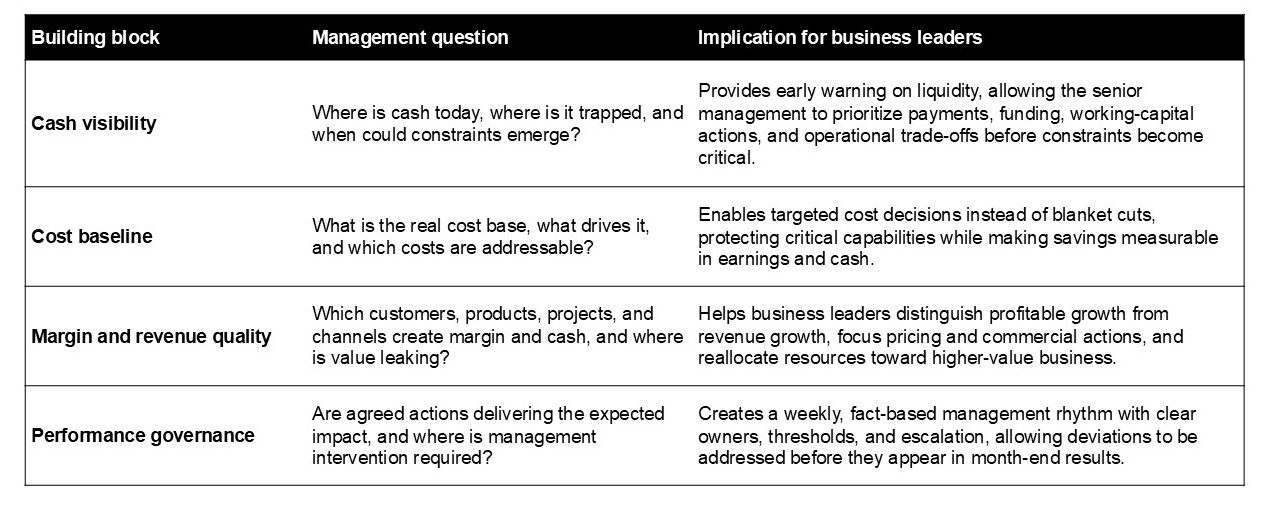
Together, these four building blocks give business leaders a clearer view of cash, cost, margin, and execution. A finance control tower brings this information into one management view, helping teams spot risks earlier, make better-informed decisions, and assign clear ownership for follow-up actions. Used consistently, it strengthens day-to-day performance management while helping the business prevent, prepare for, and respond to financial pressure.
References
[1] Harvard Business Review – Rosabeth Moss Kanter, Leadership and the Psychology of Turnarounds (2003): https://hbr.org/2003/06/leadership-and-the-psychology-of-turnarounds
[2] Allen, J., Jimmieson, N. L., Bordia, P., and Irmer, B. “Uncertainty during Organizational Change: Managing Perceptions through Communication.” Journal of Change Management, Vol. 7, No. 2, 2007, pp. 187–210: https://doi.org/10.1080/14697010701563379
[3] Schrage, M. et al. “The Future of Strategic Measurement: Enhancing KPIs With AI.” MIT Sloan Management Review, February 2024: https://sloanreview.mit.edu/projects/the-future-of-strategic-measurement-enhancing-kpis-with-ai/
[4] Mankins, M., and Litre, P. “Transformations That Work.” Harvard Business Review, May–June 2024: https://hbr.org/2024/05/transformations-that-work