K-beauty went global and its system must follow
19 October 2026 — K-beauty has proved it can scale globally. The next test is whether its operating system can scale with it, turning expansion into stronger brands and companies rather than more isolated channels and transactions for Korean-made products.






Problem
K-beauty’s global success is weakening the conditions that created it. Manufacturing expertise and product ideas are becoming less exclusive, while overseas expansion disconnects demand, market support, consumer feedback and decisions. Brands may reach shelves without becoming more distinctive or building lasting markets.
Why it happens?
As production capabilities spread and products converge faster, brands adopt similar playbooks and compete for the same markets, partners and shelf space. Across the value chain, brands, distributors and retailers move quickly to capture K-beauty demand, but each controls a different part of commercialization and allocates resources based on different priorities.
Solution
No company needs to own every step. What matters is keeping demand, market support and local learning connected across partners. The economics must give each side a reason to invest in market development, while the resulting insight informs the next decision. Each sale should generate revenue and make the system behind the next one stronger.
Download this post (PDF)
See K-beauty as a system, not a product trend
South Korea exported USD 11.4 billion of cosmetics in 2025, becoming the world’s second-largest cosmetics exporter. Those products reached 202 markets, up from 172 a year earlier[1],[2]. K-beauty is no longer a niche trend waiting to be discovered. It is an industrial success.
K-beauty’s rise is commonly attributed to effective products at accessible prices, rapid innovation, Korean cultural influence and digital discovery. All matter. Less visible is the system that connects demand creation, industrialized production and retail validation, turning those familiar advantages into repeated commercial momentum.
Korea’s beauty ecosystem actively creates demand for new textures, formats and routines. Toner pads, ampoules, hydrogel masks, sun sticks and cushions asked consumers to learn unfamiliar formats or add new steps to familiar routines. Sampling and review programs, creators and concentrated retail exposure made these products visible, understandable and socially validated. Beauty is also embedded in everyday Korean life, creating a collective vocabulary for consumption and marketing: K-pop idol looks are translated into reproducible techniques and product choices, widespread access to skin clinics and aesthetic procedures makes clinical skincare concepts familiar[3], and popular beauty trends such as personal-color analysis give consumers a shared language for color cosmetics[4].
That demand creation is tightly connected to industrialized product development and concentrated retail validation. Brands monitor consumer response, while Korea’s highly industrialized network of cosmetics original design manufacturers, or ODMs, rapidly translates emerging ideas into commercially scalable products. Olive Young, South Korea’s dominant beauty and wellness retailer[5], reinforces the cycle through regular new-product promotions and four seasonal mega-sales that concentrate attention on new products and emerging trends. Visible sales results then influence what brands, manufacturers and creators develop, promote and scale next.
The result is not only a few famous brands. In 2025, 116 brands generated more than KRW 10 billion in annual sales through Olive Young, up from 36 in 2020[6]. Few beauty markets connect demand creation, industrialized production and retail validation within one such fast-moving loop. Korea can therefore test more ideas, identify winners earlier and introduce them globally faster.
Recognize how scale redistributes the advantage
As K-beauty expands, two of its advantages are becoming less exclusive: access to Korea’s industrial base and the novelty of its products. Cosmax, one of Korea’s leading ODMs, operates factories in five countries⁷ and supplies 18 of the world’s 20 largest beauty groups[8]. Rhode, the American brand founded by Hailey Bieber, makes its viral Pocket Blush in Korea[9]. German drugstore chain Rossmann has gone further, launching its own ISANA K-beauty range developed and produced in Korea[10]. This is an industrial achievement for Korea, as Korean ODM expertise is becoming infrastructure for global beauty. However, it also means that this is not an exclusive advantage for Korean brands anymore.
As access widens, novelty also expires faster. Once an ingredient, texture or claim succeeds, suppliers and brands can produce variations quickly. This is a familiar playbook in Korea. It works there because consumers know the brands, follow rankings and reviews, and compare competing versions within a rich local context. Overseas, many of those cues disappear. When you put several unfamiliar brands with the same PDRN ingredient, clean packaging and glass-skin promise on a dedicated K-beauty shelf, the K-beauty category is clear but the difference between brands is not.
Korea’s beauty infrastructure remains a strong national asset, but as production capabilities spread and products become more similar, brands must find new ways to differentiate. The challenge is no longer whether K-beauty can succeed overseas, but whether brands can sustain and scale that success across fragmented markets.
Global growth pulls the system apart
K-beauty is quickly standardizing a globalization playbook. TikTok creates discovery; Amazon, TikTok Shop and cross-border platforms convert it; distributors such as Silicon2 provide logistics and channel access; and those who get traction move into Sephora, Ulta and local retail chains[5],[11]. Brands are also adopting familiar global beauty tactics, from broader shade ranges[12]. region-exclusive editions and local creator seeding to global celebrity exposure and prestige retail activations. Cardi B has featured products from several Korean skincare brands[13] while AMUSE[14] and Beauty of Joseon[15] have staged pop-ups at Galeries Lafayette in Paris.
And the fear of missing out does not stop with brands. In our work in the industry, we have seen distributors rush to secure emerging brands and compete for exclusivities as soon as a new name begins to heat up. Retailers, from global beauty chains to local supermarkets and pharmacies, are also moving quickly to build or expand their K-beauty categories.
Demand is real, commitments follow quickly and ambitions are high. Yet the connected operating system that supported K-beauty at home does not travel automatically with its products. As the work is split among brands, distributors, retailers and platforms, we repeatedly see two connections weaken in practice.
The first disconnect: from market access to sustained market development
Strong interest in K-beauty can help brands enter new markets before they have built lasting consumer demand. When demand is strong, distributors and retailers have clear reasons to prioritize a brand. The harder case is when one brand can be readily replaced by another with similar positioning. Distributors and retailers then manage according to the needs of their wider portfolios, which may not match the ambition agreed at kickoff. Exclusivity and trust between partners can also influence where support goes. This matters because most brands still depend heavily on local partners to build the market. In our work, even with frequent business trips and retailer meetings, brands often do not know whether a launch is still receiving the inventory, activation and management attention it needs. Nor can they fully control how those resources are allocated.
The second disconnect: from local market evidence to business decisions
A natural response is to create more demand from upstream: make the buzz large enough, so distributors and retailers have more reason to prioritize the brand. But this runs into the second disconnection: local market evidence can lose its connection to decision-making. After launch, brands need more detailed feedback than they did when entering the market. In Korea, concentrated retail channels, promotions and review programs make consumer feedback easier to collect and act on. Overseas, this feedback is spread across multiple partners, making it harder to understand what drives sales. For example, a brand may know that one product sells better than another, but not whether the difference comes from consumer preferences, stock availability, pricing or promotions. Yet decisions on products, production and marketing often remain with the brand. As a result, valuable local insights may arrive too late or without enough context to inform the next product or investment decision.
In Korea, these challenges also exist, but concentrated retail channels and clear sales signals help brands turn market access into sustained support and consumer insights into action. Overseas, reliance on local partners in different markets makes it harder to connect market execution with business decisions. The challenge is therefore not whether to operate directly or through distributors, but how to maintain these connections as the business scales.
Reconnect the system with the right economics
Recent moves across the value chain show different ways to reconnect capabilities. Sephora’s August 2026 launch brought 19 Olive Young-curated brands to more than 500 U.S. stores and online, drawing on their performance, consumer popularity and trend leadership in Korea[16] Goodai Global, the group behind Beauty of Joseon and TIRTIR, moved downstream by acquiring U.S. distributor Hansung USA[17]. Global distributors such as Silicon2 combine wholesale distribution and logistics with consumer channels, brand incubation and physical retail[11].
These moves bring product discovery, distribution and retail execution closer together, partially reconnecting the system. But more partnerships do not automatically resolve the underlying economic tension between stakeholders. The challenge is to make the economics work for each party, so everyone has a reason to stay committed to developing the market.
A distributor may build retail relationships, run campaigns and assign a local team before meaningful sales arrive. Once demand is established, the brand has more options: another distributor may offer better terms, or the brand may decide to manage the market itself. If distributors cannot expect to benefit from the growth they help create, they have less incentive to invest in developing the market from the outset.
The brand has reasons to preserve that flexibility. An exclusive partner may fall short of agreed support or lack the channels needed for further expansion. Without clear commitments and review points, a long agreement can protect the distributor’s position while limiting the brand’s development. Retailers add another dependency: they need evidence of demand before committing more shelf space and promotional support.
These tensions help explain why market entry can advance faster than market development. Each company may be making a reasonable decision for its own business, while growth depends on their efforts working together.
A workable model gives partners enough time to develop the market, with continued distribution rights tied to agreed support and results. Meanwhile, brands need useful information, a role in local decisions and room to expand as demand grows. The right balance gives partners confidence to invest while preserving the brand’s ability to shape its next stage of growth.
For brands: own market development and market knowledge
In our work, we regularly see channel conflicts when expansion follows distributors’ available network rather than a clear market strategy. A brand may enter department stores in one region and supermarkets in another, with prices and messages that pull its positioning in different directions. Either channel can work, but each choice should support the consumer and market position the brand intends to build. Otherwise, each partner ends up shaping the brand around what it finds easiest to sell.
To avoid this, brands need to answer three connected questions for each market.
1. What must we control ourselves?
The brand should define the target consumer, the reason to choose its products and the intended price positioning before deciding how to expand. A go-to-market roadmap should translate those choices into priority channels, products and launch activities. Local partners should then adapt the approach using their market expertise, but within an agreed brand direction.
The brand also needs to build and retain its own market knowledge. This requires access to sales data by product and channel, alongside information on inventory, pricing and marketing activities. These insights help the brand refine its market strategy and make informed decisions, even when partners change.
2. What should partners be responsible for?
Once the brand has defined what it needs to control, it should determine where partners can add value. This means identifying the capabilities needed for growth, from retailer access and local marketing to logistics and regulatory support, and deciding which are best handled internally or by partners.
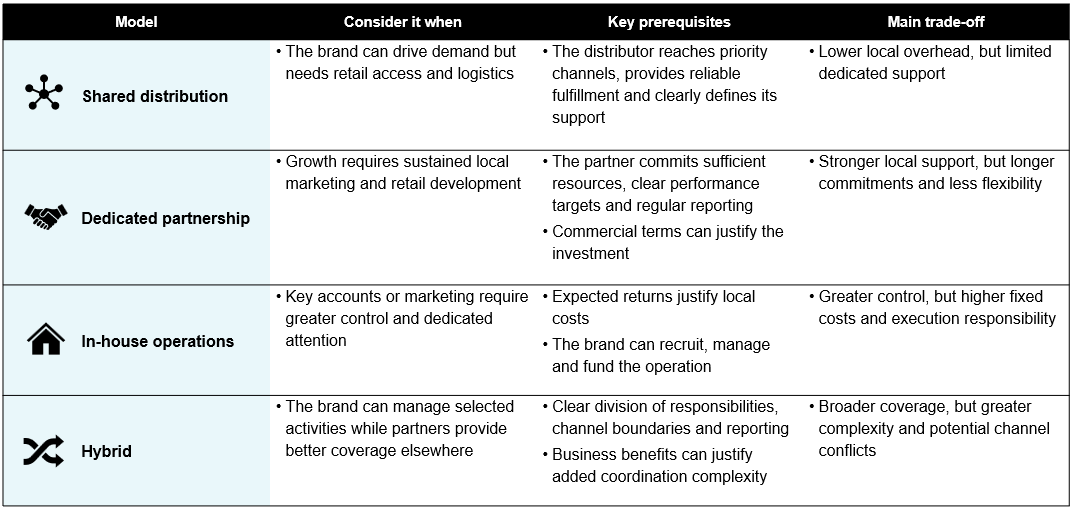
Brands do not need to move from distribution to in-house operations, or follow a single path as they grow. Company size affects what they can afford, but different markets and different activities within them may call for different models. In our work, a Korean beauty brand established a European operation and entered a major retailer, then sought distributors to reach additional channels. Its local team gave the brand an initial foothold; partners brought the relationships needed for wider coverage. The optimal arrangement can therefore change as demand, coverage and capabilities evolve.
3. How do we ensure the economics work?
Working with partners changes how costs, investments and risks are shared. Clear commitments therefore depend on economics that give each party confidence its investment will pay off. A joint business plan should define responsibilities, targets, budgets and staffing for accounts, marketing, stock and reporting. Commercial terms should give partners confidence to invest while allowing the brand room to expand: exclusivity can cover agreed channels, territories and periods, with renewal tied to support and results.
Reviews should connect sales performance with delivery against those commitments, guiding adjustments and further investment. Agreements should also address unmet commitments and launch investments if the partnership ends.
For distributors and platforms: build an advantage beyond individual brands
For distributors, the priority is to build capabilities and retailer relationships that remain valuable even when individual brands leave. This means developing expertise in brand selection, market development and retail execution.
These capabilities create more value for retailers by helping them connect Korea’s product pipeline to what local consumers are likely to buy. A distributor can help distinguish a promising launch from another version of what is already on the shelf, build a coherent assortment and focus support on products with real potential. Because it sees results across brands and channels, it can bring a broader market view than any one brand’s local team. If retailers trust that judgment and execution, they still have a reason to work with the distributor even when an individual brand changes partners or begins supplying them directly.
Portfolio discipline protects that value. New brands should strengthen the distributor’s chosen role with retailers and fit the support it can sustain. Otherwise, portfolio expansion dilutes the curation and execution that make the business valuable. The aim is for a changing portfolio to deepen expertise and retail relationships, so growth leaves the distributor stronger.
For investors and acquirers: examine what growth leaves behind
Investors should examine demand beyond launch promotions and a single viral product, using consumer sell-through, repeat purchases and retailer commitment. These signals should be assessed alongside the marketing, inventory and local operating costs required to sustain sales.
They should also look for evidence that market experience improves the business. Can the company explain how local results changed its product range, positioning or channel decisions? Would useful knowledge and relationships survive a partner change? For a distribution acquisition, the investment case should show how the combined business will improve these activities and translate those improvements into stronger earnings.
K-beauty has proved it can scale products globally. Its next advantage depends on keeping market development, execution and learning connected as markets and partners multiply. Every international sale should generate revenue and strengthen the system behind the next one.
References
[1] Yonhap News Agency (2026). Exports of K-beauty products hit all-time high in 2025: data. Retrieved at https://en.yna.co.kr/view/AEN20260109010100320 on October 15, 2026.
[2] Korea JoongAng Daily (2026). Korea surpasses U.S. in cosmetics exports with record $11.4 billion. Retrieved at https://www.koreajoongangdaily.com/business/korea-surpasses-us-in-cosmetics-exports-with-record-114-billion/12713991 on October 15, 2026.
[3] Korea Tourism Organization (2025). Korean Dermatology Clinics, the Center of K-beauty with a Global Reach. Retrieved at https://english.visitkorea.or.kr/svc/contents/contentsView.do?menuSn=923&vcontsId=220188 on October 15, 2026.
[4] TIME / Bloomberg (2023). ‘Personal Color Analysis’ Has Gone Viral—Fueling a Tourism Boom for South Korea. Retrieved at https://time.com/6299099/personal-color-analysis-korea-tourism/ on October 15, 2026.
[5] Reuters (2025). K-beauty startups bet booming US demand outlasts tariff pain. Retrieved at https://www.reuters.com/world/asia-pacific/korean-beauty-startups-bet-booming-us-demand-outlasts-tariff-pain-2025-06-05/ on October 15, 2026.
[6] CJ Olive Young (2026). From Indie to Icon: 116 K-Beauty Brands Exceed 10 Billion KRW in Sales at Olive Young. Retrieved at https://newsroom.cj.net/from-indie-to-icon-116-k-beauty-brands-exceed-10-billion-krw-in-sales-at-olive-young/ on October 15, 2026.
[7] Cosmax (2026). Global factories. Retrieved at https://www.cosmax.com/en/ on October 15, 2026.
[8] ChosunBiz (2025). K-beauty boom drives Kolmar, COSMAX to 2 trillion won sales. Retrieved at https://biz.chosun.com/en/en-retail/2025/02/25/HDZKOJX2QBCQRAD3VJEEVV7UZY/ on October 15, 2026.
[9] Rhode (2026). Pocket Blush customer review image showing the product label. Retrieved at https://www.rhodeskin.com/products/pocket-blush-piggy on October 15, 2026.
[10] Dirk Rossmann GmbH (2025). K-Beauty Linie der ROSSMANN-Marke ISANA. Retrieved at https://unternehmen.rossmann.de/presse/pressemeldung/k-beauty-linie-isana.html on October 15, 2026.
[11] Silicon2 (2026). Worldwide K-Beauty Platform. Retrieved at https://www.siliconii.com/en/sub/sub02_07.php on October 15, 2026.
[12] Teen Vogue (2024). How TIRTIR’s Viral Red Cushion Foundation Went From 3 to 40 Shades in Less Than a Year. Retrieved at https://www.teenvogue.com/story/tirtir-viral-red-cushion-foundation-shade-expansion-interview on October 15, 2026.
[13] Glamour (2026). How Cardi B Became South Korea’s Favorite Beauty Influencer. Retrieved at https://www.glamour.com/story/how-cardi-b-became-koreas-biggest-beauty-influencer on October 15, 2026.
[14] The Asia Business Daily (2026). Amuse Accelerates European Push with Entry into Galeries Lafayette. Retrieved at https://www.asiae.co.kr/en/article/2026031717144445795 on October 15, 2026.
[15] Galeries Lafayette (2025). Beauty of Joseon. Retrieved at https://haussmann.galerieslafayette.com/en/pop-up-beauty-of-joseon-2/ on October 15, 2026.
[16] Sephora (2026). Sephora Introduces Olive Young-Curated K-Beauty to U.S. Consumers Beginning August 20. Retrieved at https://newsroom.sephora.com/sephora-introduces-olive-young-curated-k-beauty-to-u-s-consumers-beginning-august-20/ on October 15, 2026.
[17] Seoul Economic Daily (2026). K-Beauty Firm Goodai Global Acquires US Distributor for 100 Billion Won. Retrieved at https://en.sedaily.com/finance/2026/02/03/k-beauty-firm-goodai-global-acquires-us-distributor-for-100 on October 15, 2026.
Tags
South Korea, Operating model, K-beauty, Beauty industry, Global expansion, Cosmetics, Beauty retail, Consumer demand, Investment analysis