From memory strength to system capability – why Europe matters for Korea’s next semiconductor chapter
30 July 2026 — Korea can turn today’s AI memory success into tomorrow’s semiconductor leadership. Europe offers the partnerships, validation, and industrial ecosystems needed to accelerate the move beyond memory.







Problem
Korea's AI-driven memory boom has strengthened its semiconductor industry, but it also risks delaying progress beyond memory, leaving Korea less prepared for the next wave of system semiconductor competition.
Why it happens?
The strong profitability of memory attracts capital, talent, policy support, and management attention, reducing investment in application-specific chips and system-level capabilities where future growth will increasingly be created.
Solution
Korea should use the current memory cycle as the foundation for the next phase of its semiconductor agenda, not as proof that the existing model is sufficient. Europe can help Korean firms build capabilities beyond memory and open the door to long-term system partnerships.
Download this post (PDF)
Memory strength should enable Korea’s next semiconductor push
Korea’s memory boom has strengthened the country’s position in the global semiconductor market. In May 2026, Korean semiconductor exports rose 169% year-on-year to a record 37BUSD and accounted for more than 42% of Korea’s total exports[1]. Samsung and SK Hynix also held roughly two-thirds of the global DRAM market in Q1 2026, with shares of 38% and 29%, respectively[2].
The near-term market outlook remains positive. International Data Corporation (IDC) projects global semiconductor revenue of 1.3TUSD in 2026[3], driven by AI infrastructure, hyperscaler investment, and memory demand, while Deloitte offers a more conservative estimate of 975BUSD for 2026[4]. Though the exact figure is uncertain, the upward trend is clear, and AI is fueling one of the strongest semiconductor cycles in history.
The risk is not that memory demand will suddenly collapse. The greater risk is that the current boom absorbs the capital, talent, and management attention that Korea’s semiconductor industry needs to build its next layer of competitiveness. Korea should leverage its memory strength as a platform to build new capabilities, rather than letting excessive focus on memory delay further progress.
Korea’s beyond-memory path should reflect Korea’s own industrial strengths
The US model is useful because it shows that semiconductor leadership is increasingly ecosystem-based. In the US, that ecosystem is built around hyperscale cloud infrastructure, software platforms, venture-backed fabless firms, AI accelerator design, EDA leadership, and developer ecosystems such as Nvidia’s CUDA[5]. These strengths reflect decades of accumulated capabilities in software, cloud computing, and digital platforms.
Korea needs a beyond-memory path with a different ecosystem, one built around its own strengths. Its current memory leadership is powerful, but a memory-centered model alone does not fully capture the value of Korea’s broader industrial base in batteries, displays, consumer electronics, automotive manufacturing, advanced packaging, and high-volume manufacturing[6].
Future semiconductor demand is increasingly tied to the digitization of vehicles, factories, energy systems, robots, industrial equipment, and connected devices[7]. In these areas, success depends not only on computing power, but also on the integration of sensing, memory, power management, connectivity, safety, reliability, thermal management, and system-level optimization[8].
Korea’s non-memory strategy should therefore focus on extending its semiconductor strengths into markets where chips are not sold as standalone components but embedded into physical systems. Examples are automotive semiconductors, edge AI accelerators, industrial processors, sensors, power management ICs, connectivity solutions, robotics controllers, and application-specific chips for real-world conditions[9].
Europe provides a path to beyond-memory capabilities and long-term partnerships
Europe is not the obvious answer if the question is only market size. Its importance lies in the nature of demand: customers require deeper integration into complex physical systems.
European industrial buyers tend to be conservative and risk-averse, especially when components are embedded into long-lifecycle systems. Supplier qualification is therefore not a simple commercial step, but a rigorous validation process that requires evidence of reliability, documentation discipline, traceability, and long-term support capability.
Europe is also a highly contested market. It already has deep semiconductor and industrial incumbents, including Infineon, STMicroelectronics, NXP, Bosch, ASML, and imec-linked ecosystems. Japan remains strong in automotive electronics, Taiwan dominates foundry orchestration, the US leads in software platforms, and China is localizing aggressively.
This combination of demanding system-level customers and entrenched competitors is what makes Europe strategically useful for Korea. It is not an easy growth market, but a demanding qualification environment where Korean firms can develop the capabilities needed beyond memory and gain access to more predictable long-term customer relationships.
Korea’s Europe playbook should be selective: three priority beachheads
Europe should not be treated as one homogeneous semiconductor market. Korean firms should prioritize the ecosystems that create the strongest learning and qualification value, rather than spreading effort across every country equally.
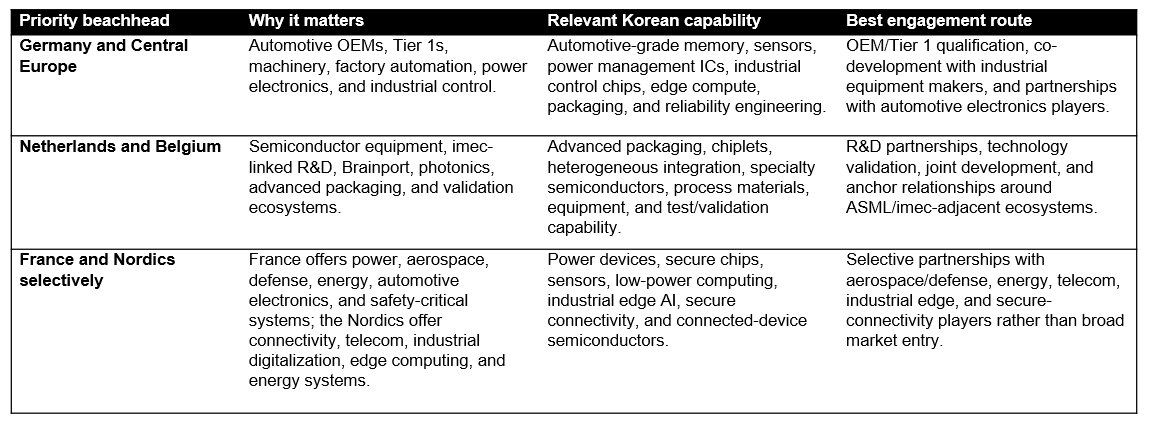
Other ecosystems remain relevant but should be treated more selectively. Italy, Austria, and Switzerland can be useful for precision manufacturing, industrial equipment, MEMS, sensors, control chips, and application-specific semiconductors. However, they should be pursued when there is a clear partner, reference case, or niche application rather than as standalone national priorities.
Automotive and industrial applications are the most practical entry points
Automotive and industrial applications are the clearest examples of where semiconductor suppliers must meet customer requirements at the complete-system level. In the automotive industry, the shift toward software-defined vehicles is driving demand for centralized compute, zonal controllers, ADAS processors, high-reliability memory, image sensors, connectivity chips, power management ICs, security chips, and advanced packaging.[10] In industrial applications, edge systems and automation are increasing the need for sensors, power devices, control chips, connectivity, and reliable embedded computing.
The EU automotive sector supports more than 13 million jobs across the value chain and accounts for roughly one-third of the EU’s total R&D spending[11], and McKinsey estimates that the automotive semiconductor market could expand from around 60BUSD to 140BUSD by 2032, driven in part by the move toward centralized and zonal vehicle architectures[12]. Europe is also a major industrial automation market, with 85,000 industrial robots installed in 2024, and Germany alone accounting for nearly one-third of European installations[13].
For Korea, the opportunity lies at system-level entry points where its existing industrial base creates an advantage: memory and packaging for centralized compute, battery-linked power and control solutions, display and sensor modules, and edge AI hardware for factory automation.
Different Korean players need different Europe routes
The implication is not that every Korean semiconductor company should open a European sales office. Europe’s relevance should be defined by the role different Korean players can realistically play.
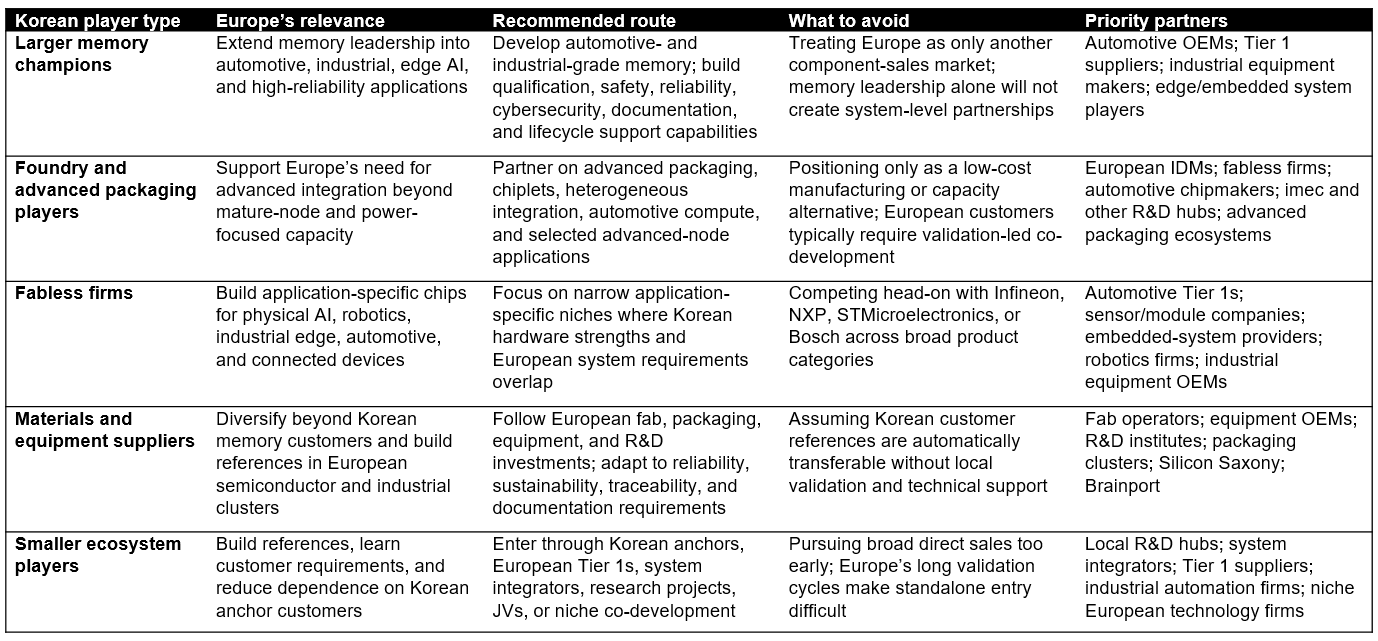
In short, for large Korean players, Europe can become a route toward long-term technology partnerships. For smaller firms, it is primarily a way to build references, qualification experience, and application-specific capabilities through partners rather than broad direct sales.
Four actions for Korean semiconductor leaders
-
Define Europe by what the company wants to learn or prove, not country coverage
A memory champion, packaging company, fabless firm, and materials supplier each require a different Europe strategy. The starting point should be the capability to build automotive qualification experience, advanced packaging validation, industrial edge reference cases, or application-specific design experience.
-
Select two or three targeted qualification pathways
Korean firms should avoid pursuing many generic opportunities at once. More practical pathways include automotive-grade memory with German Tier 1s, advanced packaging validation in Belgium or the Netherlands, or industrial edge AI chips with automation and energy-system partners.
-
Build from the first credible European customer reference
The initial objective may not be immediate revenue. A qualified design-in, co-developed module, validated packaging approach, or credible customer reference can be more valuable because it proves that Korean firms can meet European system requirements.
-
Organize smaller ecosystem players around anchor relationships
Smaller Korean firms serving Samsung, SK Hynix, or other domestic anchors can use Europe to learn reliability, documentation, sustainability, lifecycle, and system-integration requirements. But they will usually need partner-led routes through Korean anchors, European Tier 1s, system integrators, research projects, or niche co-development.
Conclusion – Europe can help Korean firms move beyond memory
Korea’s next semiconductor chapter should not be framed as a choice between memory and non-memory. Memory is the base. The next task is to use that base to build stronger positions in ecosystems where semiconductors are embedded into larger, complex physical systems. Europe will not be an easy market, given its fragmentation, conservative customers, and strong incumbents. But that is precisely why it matters. Europe can help Korean firms make the transition from world-class component suppliers to long-term system partners in the industrial domains where semiconductor value will increasingly be defined. For Korean executives, the next step is practical: choose the right European beachheads, build credible customer references, and work through partners where direct entry is too slow or costly.
Reference
[1] Reuters (2026). South Korea export growth hits four-decade high on AI chip boom. Retrieved at https://www.reuters.com/world/asia-pacific/south-korea-export-growth-hits-four-decade-high-chip-sales-hit-record-ai-boom-2026-06-01/ on July 13, 2026
[2] Counterpoint Research (2026). Global DRAM and HBM Market Share: Quarterly. Retrieved at https://counterpointresearch.com/en/insights/global-dram-and-hbm-market-share on July 13, 2026
[3] IDC (2026). Semiconductor Market Forecast 2026: The AI Supercycle Arrives. Retrieved at https://www.idc.com/resource-center/blog/semiconductor-market-to-surge-past-the-trillion-dollar-threshold-ai-infrastructure-drives-market-growth on July 13, 2026
[4] Deloitte (2026). 2026 Global Semiconductor Industry Outlook. Retrieved at https://www.deloitte.com/us/en/insights/industry/technology/technology-media-telecom-outlooks/semiconductor-industry-outlook.html on July 13, 2026
[5] Semiconductor Industry Association (2025). 2025 SIA Factbook. Retrieved at https://www.semiconductors.org/wp-content/uploads/2025/05/2025-SIA-Factbook-FINAL-1.pdf on July 13, 2026
[6] OECD (2024). The Semiconductor Supply Chain: Opportunities and Challenges. Retrieved at https://www.oecd.org/industry/semiconductors-and-global-value-chains.htm on July 13, 2026
[7] World Economic Forum (2025). Industries in the Intelligent Age. Retrieved at https://www.weforum.org/reports/industries-in-the-intelligent-age on July 13, 2026
[8] European Commission Joint Research Centre (2024). EU’s Strengths and Weaknesses in the Global Semiconductor Value Chain. Retrieved at https://publications.jrc.ec.europa.eu/repository/bitstream/JRC141323/JRC141323_01.pdf on July 13, 2026
[9] Infineon Technologies AG (2024). Annual Report 2024. Retrieved at https://www.infineon.com/assets/row/public/documents/corporate/investors/annual-reports/2024/2024-infineon-annual-report-01-00-en.pdf?fileId=8ac78c8b92bced620193694bfb970095 on July 13, 2026
[10] McKinsey & Company (2024). Mapping the automotive software-and-electronics landscape through 2030. Retrieved at https://www.mckinsey.com/features/mckinsey-center-for-future-mobility/our-insights/mapping-the-automotive-software-and-electronics-landscape on July 13, 2026
[11] ACEA (2024). The Automobile Industry Pocket Guide 2024/2025. Retrieved at https://www.acea.auto/files/ACEA-Pocket-Guide-2024-2025.pdf on July 13, 2026
[12] McKinsey & Company (2024). Advanced semiconductors for the era of centralized E/E architectures. Retrieved at https://www.mckinsey.com/industries/semiconductors/our-insights/advanced-semiconductors-for-the-era-of-centralized-e-e-architectures on July 13, 2026
[13] International Federation of Robotics (2025). World Robotics 2025 report – Industrial Robots. Retrieved at https://ifr.org/ifr-press-releases/news/global-robot-demand-in-factories-doubles-over-10-years on July 13, 2026